


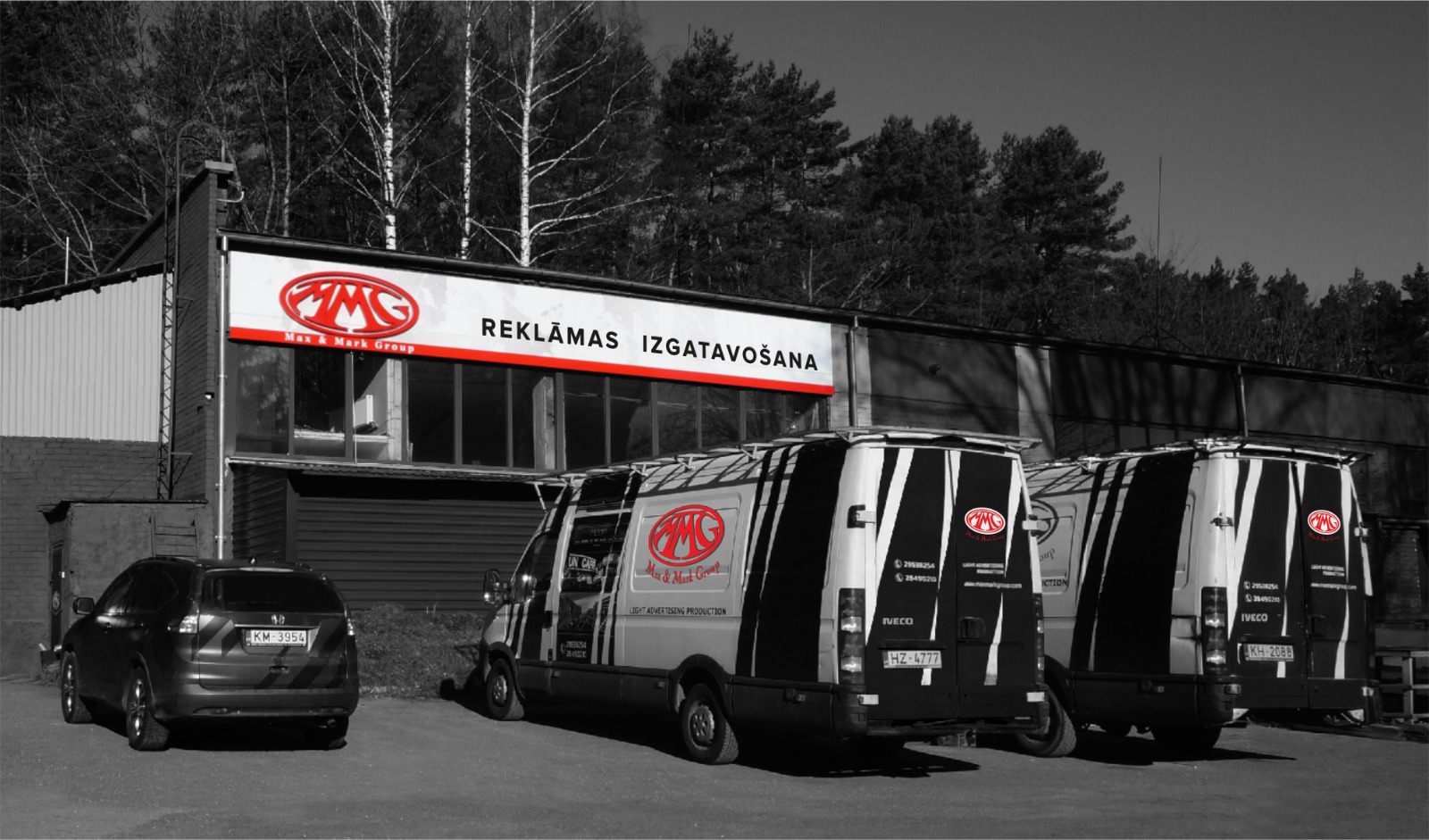
The company’s employees are highly qualified professionals with extensive experience in the advertising field. We create professional designs, perform design calculations, assist with outdoor advertising registrations, and provide advice on all matters related to the production and placement of outdoor advertising. Installation teams install designs of any complexity quickly and perform all necessary electrical installation work.
We hope for further cooperation!
With respect
The company “MMG Group Ltd”
Some manufacturers build advertising structures. Others build reputations. The difference lies not in the machinery or the materials — it lies in how a company thinks about its clients’ problems before a single calculation is drawn or a weld is made.
This is the story of how a creative studio operating out of Riga evolved into one of Latvia’s most respected outdoor advertising manufacturers: not through luck or scale, but through the deliberate decision to treat every project as a long-term investment in a client’s brand, rather than a transaction to close.
The following pages examine what sets a genuine full-cycle advertising production company apart — technically, strategically, and commercially — and why the details that most clients never see are precisely the ones that determine whether an advertising structure pays for itself over time or becomes a liability.
From Studio to Manufacturer: The Decision That Changed Everything
Most advertising production businesses in Central and Eastern Europe began as print shops or creative agencies. The natural trajectory was to design visuals, subcontract the fabrication, and manage relationships. It was a comfortable model — until clients began asking harder questions.
Why did the banner fade in eighteen months when the supplier promised UV stability? Why did the freestanding totem shift after the first autumn storm? Why did the lightbox frame show surface rust within three years of installation? These were not questions a design studio could answer from a monitor.
The pivot to full in-house manufacturing was driven by accountability. When a company controls every stage — from structural engineering and material sourcing to fabrication, finishing, and installation — it can guarantee outcomes, not just intentions. That accountability is the foundation on which this outdoor advertising production company was built.
What Full-Cycle Production Actually Means
The term is used loosely across the industry. True full-cycle production means that the same organisation that designs your advertising structure also calculates its load-bearing requirements, procures the steel or aluminium, operates the CNC cutting and welding equipment, applies the surface treatment, prints the graphics, and installs the finished unit on site.
Each handoff eliminated is a quality risk removed. When fabrication and design sit in the same facility, engineers catch design decisions that look elegant on screen but create structural weaknesses in practice. When printing and installation are coordinated internally, the graphics are produced to tolerances that fit the frame — not approximated and trimmed on site.
Engineering First: Why Structural Thinking Protects Your Investment
Outdoor advertising operates in an uncontrolled environment. Sun, frost, wind, and vibration stress every component differently depending on the site, the orientation, and the season. A billboard structure that performs flawlessly in a sheltered urban courtyard may fail within two winters if installed on an exposed highway median where prevailing westerly gusts regularly exceed 90 kilometres per hour.
Structural engineering is not a compliance checkbox. It is the foundation of cost-of-ownership. A frame designed to handle 120 km/h wind loads with a 20% safety margin will not require early remediation. A frame designed to minimum specification — or, worse, without formal calculation — will.
Wind Load and Structural Calculations: What Clients Should Ask For
Any reputable outdoor advertising manufacturer in Riga will produce a formal structural calculation document before fabrication begins. This document should specify:
- The design wind speed for the installation location, derived from Latvian and European EN 1991-1-4 norms
- The dynamic pressure acting on the structure’s surface area
- The bending moments and shear forces acting on the primary support column or frame
- The foundation requirements — anchor depth, concrete grade, and bolt-pattern specifications
- The safety factor applied to all critical members
Clients who receive this documentation own an asset that has been engineered, not guessed at. Clients who do not receive it are accepting a risk they may not discover until the structure is already installed — and the manufacturer is already on the next project.
Material Selection and Long-Term Cost of Ownership
The single most consequential material decision in outdoor advertising fabrication is how the primary steel structure is protected against corrosion. Hot-dip galvanising and zinc-powder coating are not the same process, and the difference in service life is substantial.
Hot-dip galvanising immerses fabricated steel in a bath of molten zinc at approximately 450 degrees Celsius. The zinc metallurgically bonds with the steel surface, creating a barrier that sacrificially corrodes in preference to the underlying metal. A properly galvanised structure in a temperate Baltic climate will retain structural integrity for 25 years or more without remediation.
Zinc-powder epoxy coatings are applied cold, adhere mechanically rather than metallurgically, and will eventually delaminate at edges and weld seams — areas of highest mechanical stress and lowest coating adhesion. A structure relying solely on powder coating in an exposed location should be inspected annually and expects first remediation within eight to twelve years.
Understanding this distinction is not pedantic. For a client commissioning ten roadside totems across a national network, the difference between a 12-year and a 25-year maintenance cycle represents a significant capital cost.
Material Comparison: Choosing the Right Specification for Your Project
The table below provides a practical reference for the most common structural and facing materials used in signage production in Latvia. Specifications vary by design and environmental exposure; consult with a structural engineer for site-specific guidance.
Selection should always balance initial capital cost against the projected maintenance schedule. A composite panel facade costs more per square metre than PVC flex, but for a permanent retail installation expected to operate for fifteen years, the total cost of ownership — including replacement cycles and installation labour — consistently favours the higher-specification material.
Design of Advertising Structures: Where Strategy Meets Fabrication
The design of advertising structures is a discipline that operates at the intersection of graphic communication and civil engineering. A design that ignores viewing distance, solar orientation, and the visual context of the installation site may be striking in a pitch presentation and invisible in practice.
Effective structural design starts with a sightline analysis. At what distance will a driver first see this billboard? What is their speed? How many seconds of visibility does the site geometry allow? The answers determine the minimum character height, the contrast requirements, and the degree of visual simplification needed in the graphic layout.
Visibility Engineering: The Science Behind Effective Outdoor Formats
Research into driver attention and outdoor advertising legibility consistently finds that messages requiring more than three seconds to read lose significant portions of their audience at motorway speeds. At 90 km/h, a vehicle travels 75 metres per second. A billboard that takes four seconds to read is already behind the driver before comprehension is complete.
This is why the design of advertising structures at our facility always begins with a brief that defines the installation environment before it defines the creative. Background clutter, competing signage, seasonal foliage, and changes in ambient lighting all affect legibility in ways that are invisible in a studio but immediately apparent on site.
UV Printing Technology and Colour Durability
Outdoor graphics exposed to Baltic summer UV levels without adequate protection will visibly fade within two seasons. The ink chemistry matters, but so does the substrate compatibility and the finishing overlay.
UV-cured inkjet printing on rigid substrates offers superior colour stability compared to solvent-based printing on flex banner — not because solvent inks are inherently inferior, but because UV curing creates a harder, more durable surface layer that resists abrasion, moisture ingress, and photodegradation more effectively. For permanent installations, UV printing on dibond composite panels or aluminium sheet is the recommended specification.
For flexible graphic elements — banner replacements, seasonal campaign overlays — 440-gram PVC with a clear laminate overprint extends usable life from an average of 12 months to 24-30 months, depending on solar exposure. The laminate also provides mechanical protection during installation and removal, reducing the incidence of surface damage that shortens graphic lifecycles.
The Production Process: What Happens Between Brief and Installation
Clients who engage a full-cycle advertising production company for the first time often underestimate the complexity of the production sequence. Understanding the stages — and the decisions made at each one — helps set accurate expectations for timelines and reveals why shortcuts taken early in the process create problems late.
Stage 1 — Technical Brief and Site Survey
Every project begins with a site visit and a structured technical brief. The brief captures installation surface type, soil bearing capacity or structural host, planning permission status, power availability for illuminated structures, and any local authority aesthetic constraints.
This information directly determines the structural specification. A totem installed on compacted gravel requires a different anchor system than one installed on reinforced concrete. Getting this wrong does not become apparent until the foundation crew is already on site.
Stage 2 — Engineering and Design Approval
Structural calculations are completed and reviewed before the design is finalised. This order matters. Designing first and calculating after can lock the project into a configuration that requires expensive structural compensation. Engineering first allows design to work within physical constraints from the outset.
The client sees a rendered visualisation of the finished structure in its actual site context. This is not a decorative step — it is a quality control checkpoint that catches orientation errors, scale mismatches, and colour conflicts with the surrounding environment before fabrication begins.
Stage 3 — Fabrication and Surface Treatment
Steel and aluminium components are cut, bent, and welded to drawing specification. Weld quality is visually inspected at every joint; critical structural welds are subject to non-destructive testing where load calculations indicate elevated stress concentration.
Surface treatment follows fabrication. For galvanised components, this means transport to the galvanising bath and a minimum 48-hour cure before painting. For powder-coated components, surface preparation — grit blasting to Sa 2.5 standard — is as important as the coating itself. Inadequately prepared surfaces are the primary cause of premature coating failure.
Stage 4 — Graphic Production and Assembly
Graphics are produced against the confirmed structural dimensions — not against the design drawing, which may carry rounding tolerances. The production team confirms fit before graphics are laminated or sealed. Final assembly and quality inspection occur in the facility before transport, so the installation crew arrives on site with a complete, verified unit.
Stage 5 — Installation and Handover
Professional installation is not a commodity. The structural integrity of the finished advertising structure depends as much on correct anchor torque settings, correct concrete mix and pour depth, and correct cable management for illuminated units as it does on the fabrication quality. Installation teams working under the direction of the same organisation that engineered the structure understand the specifications at first principles — not from a generic installation manual.
Handover documentation includes as-built drawings, maintenance schedules, electrical certification for illuminated units, and the original structural calculation report. This pack is the client’s assurance document and, increasingly, a requirement for corporate property and facilities management teams.
Why Businesses Choose a Local Manufacturer in Riga
The decision to work with an outdoor advertising manufacturer in Riga rather than importing structures from further afield is driven by more than cost and logistics — though both matter. It is driven by the specific knowledge that comes from operating in the same regulatory and climatic environment as the client.
Latvia’s building regulations, signage planning permissions, and structural norms all sit within the Eurocodes framework, but national annexes introduce specific requirements for wind speed zoning, snow load assumptions, and ground condition classifications. An organisation producing advertising structures in Riga works within these norms daily. Its engineers read the Latvian national annex to EN 1991 as a routine document, not an occasional reference.
Lead Times and Responsive Service
Import lead times for custom fabricated structures from distant manufacturers regularly exceed 8-12 weeks when factory schedules, shipping delays, and customs processing are factored in. A local full-cycle production company operating its own fabrication facility can complete standard projects in 3-5 weeks and handle urgent campaigns in compressed timeframes that no import supply chain can match.
Responsive service also means that design changes requested after structural work has begun can be managed — not abandoned. When the engineering team and the fabrication floor are in the same building, a client decision to alter the graphic panel dimensions on day four of a ten-day fabrication schedule can be accommodated through direct conversation, not through a chain of international emails.
FAQs about Advertisment Production
1. What does a full-cycle advertising production company actually do?
A full-cycle advertising production company manages every stage of an advertising project in-house, including design, engineering, material sourcing, fabrication, printing, and installation. This approach reduces quality risks, improves coordination, and ensures accountability from concept to completion.
2. Why is structural engineering important in outdoor advertising?
Structural engineering ensures that advertising structures can withstand environmental factors like wind, snow, and temperature changes. Proper calculations help prevent damage, reduce maintenance costs, and extend the lifespan of the installation.
3. What materials are best for long-lasting outdoor advertising structures?
Hot-dip galvanised steel is widely preferred for structural components due to its long-term corrosion resistance. For graphics, UV-printed aluminium or composite panels offer better durability compared to standard flex banners.
4. How long does it take to complete an outdoor advertising project?
Timelines vary depending on complexity, but a local full-cycle production company can typically complete standard projects within 3–5 weeks. More complex or custom installations may require additional time for engineering and approvals.
5. Why should businesses choose a local advertising manufacturer in Riga?
A local manufacturer understands regional regulations, climate conditions, and construction standards. This results in faster delivery, better compliance, easier communication, and long-term support for maintenance and future upgrades.
If you are planning an outdoor advertising campaign, a retail brand rollout, or a permanent signage installation and you need a partner who will engineer the solution correctly from day one — we would welcome the conversation. As a full-cycle advertising production company based in Riga, we handle everything from initial structural concept and site survey through to fabrication, graphic production, installation, and ongoing maintenance. Every project receives a dedicated engineering review, a formal structural calculation document, and a production schedule you can plan around.